
The Synthetic Data Trap: When More Data Makes Your Model Worse
Dec 17, 2025
datadoo research
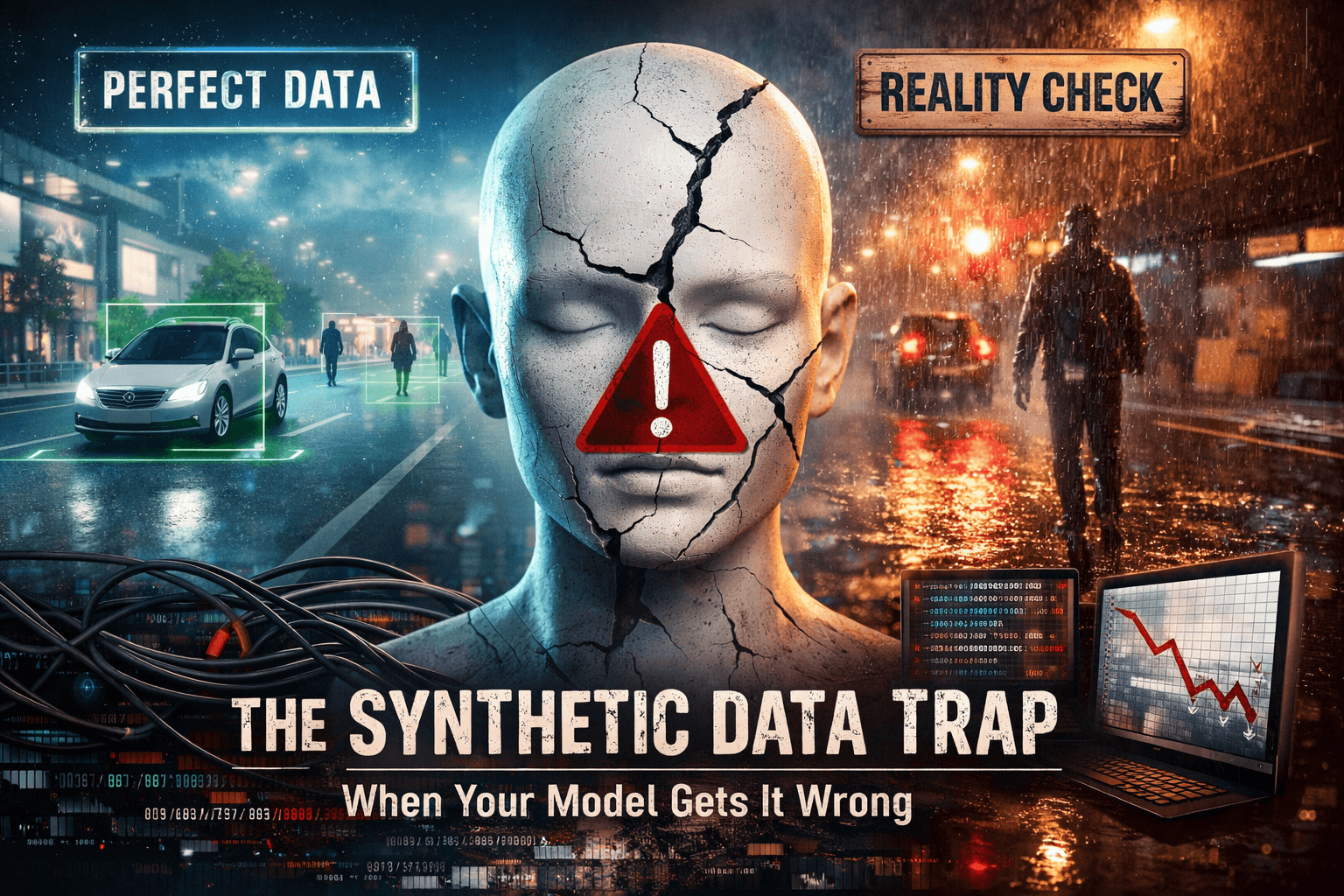
Synthetic data is everywhere right now. For good reason: real data is expensive, slow, messy, and often locked behind privacy and access constraints. Gartner famously projected that synthetic data would become a majority share of AI training data by 2024.
But there’s a quieter truth most teams learn the hard way:
If synthetic data is “almost right”, it can teach your model the wrong lessons faster than real data ever could.
This post is a reality check. No hype. Just the practical failure modes, and the fixes that actually work.
1) The most common failure: perfect worlds
Most synthetic pipelines start too clean:
Lighting that never flickers
Cameras with no blur, distortion, or rolling shutter
Surfaces that behave like plastic
Motion that looks smooth, not physical
Backgrounds that never surprise you
Then the model ships and fails on the exact stuff humans see instantly: glare, wet glass, dust, occlusion, vibration, fast motion.
If your synthetic world is simpler than the real one, your model becomes confident in a fantasy.
2) Synthetic data can improve performance, or collapse it
Synthetic data works best when it is treated like an engineering system: measurable, testable, versioned, and tied to real failure cases.
It gets risky when it turns into a loop: training on outputs that drift away from reality, then generating even more of the same. The World Economic Forum flags integrity and governance risks in synthetic data adoption, including quality and bias issues that can scale quietly.
The goal is not “more data”. The goal is “more signal where the model is blind”.
3) A 7-point checklist that catches 90% of issues
1. Start from real misses, not from a wish list
Pick 20-50 real failure clips or images. Label the failure mode in plain language:
“headlight glare hides crack”, “rain + reflections break segmentation”, “motion blur kills OCR”.
Then generate synthetic scenes that reproduce those misses on purpose.
2. Match your sensor, not your imagination
A phone camera dataset and an industrial global-shutter camera dataset do not behave the same.
Model what matters: lens distortion, exposure, noise, blur, rolling shutter, compression artifacts, frame rate.
3. Don’t randomize everything
Randomization is not realism. It is controlled variation.
Good synthetic is biased in the right direction: toward your edge cases, your long tail, your rare defects.
4. Validate on a real holdout set every time
Treat your real evaluation set like a unit test suite.
If your synthetic refresh improved training loss but did nothing on the real holdout, you added noise, not capability.
5. Measure utility, fidelity, and privacy separately
These are not the same goal.
For privacy and identifiability risk, frameworks like the UK ICO’s anonymisation guidance and NIST work on privacy guarantees and evaluation are useful anchors for how to think about “remote risk” and how to assess privacy claims. ICO+1
6. Keep provenance: what generated what, and why
Synthetic without documentation becomes un-auditable fast.
Write down:
what scenario it targets
what parameters were used
what changed since the last version
what real-world metric it is supposed to lift
7. Watch for “shortcut learning”
Models love shortcuts.
If defects always appear centered, always at the same scale, always with the same background, the model learns that pattern instead of the defect.
Deliberately break your own patterns.
4) What “good” looks like in practice
A simple pattern that works across teams:
Train baseline on real data
Evaluate and collect misses
Generate synthetic targeted at those misses
Retrain
Re-evaluate on the same real holdout
Keep only what moves real metrics
Repeat
Financial services researchers describe this same core idea: synthetic data is useful when you validate privacy risk and real-world utility, not when you assume it.
The takeaway
Synthetic data multiplies whatever you already are:
If your data strategy is disciplined, it scales wins fast.
If your data strategy is fuzzy, it scales mistakes even faster.
The teams that win in 2026 won’t be the ones generating the most synthetic data.
They’ll be the ones generating the most useful synthetic data, tied directly to real-world failure modes, measured against real-world outcomes.